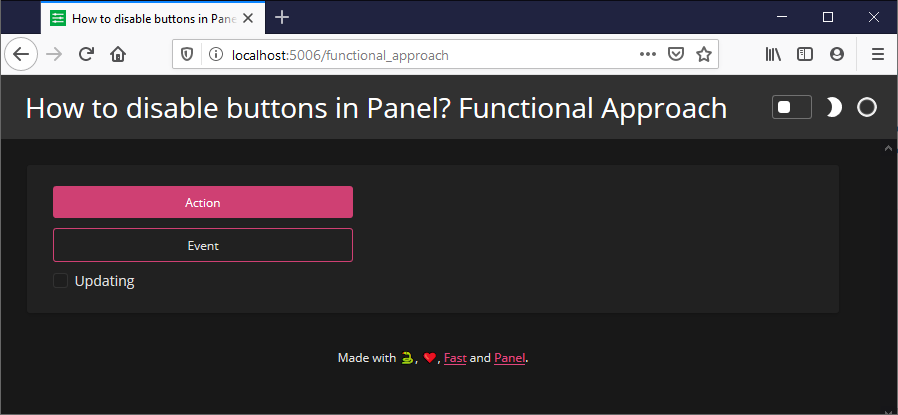
Functional Approach
The below is an attempt to solve your problem @Pill-GZ using a functional approach.
For me I really lack having for example the updating parameter to store whether or not my app is updating. I think that is simpler and more general to think about.
Combining the state of updating with the checkbox widget that is shown to the user is not a good idea I think. The updating value could just as well be shown to the user via a CheckButton, String, an Indicator or something else.
import time

import panel as pn

pn.extension()

# Create Domain Functions. I.e. the functions that solves your problem.
# For example extracting, transforming or loading data
# For example creating visualizations

def print_something():
    print('something')
    time.sleep(1)

# Create Widgets and wire them together
updating_checkbox = pn.widgets.Checkbox(name="Updating", disabled=True, )
action_button = pn.widgets.Button(name="Action", button_type="primary")
event_button = pn.widgets.Button(name="Event", button_type="success")

def start_updating():
    updating_checkbox.value = True
    action_button.disabled = True
    event_button.disabled = True

def stop_updating():
    action_button.disabled = False
    event_button.disabled = False
    updating_checkbox.value = False

def click_handler(event):
    if updating_checkbox.value:
        return

    start_updating()
    print_something()
    stop_updating()

action_button.on_click(click_handler)
event_button.on_click(click_handler)

# Create the Layout and serve the app

template = pn.template.FastListTemplate(
    title="How to disable buttons in Panel? Functional Approach", theme="dark"
)
template.main[:]=[
    pn.Column(
        action_button,
        event_button,
        updating_checkbox
    )
]

template.servable()